Predicting the future is easier when you have Q on the payroll. Across six decades, the Bond films have imagined gadgets, ambitions and dangers that later acquired real-world counterparts.
Some were clever extensions of existing science. One inspired an actual invention. Others were coincidences that make an old film feel unexpectedly topical. Reality rarely followed the screenplay exactly—but it sometimes came remarkably close.
1. Thunderball: A plot that surfaced off Spain
 Image: TMDB
In Thunderball (1965), SPECTRE hijacks a bomber carrying two nuclear weapons, conceals the aircraft underwater and holds the world to ransom. The nightmare hinges on a simple question: what happens when nuclear bombs disappear into the sea?
The following year, that question became uncomfortably real. An American B-52 collided with a tanker aircraft above Palomares, Spain, dropping four hydrogen bombs. One landed in the Mediterranean, triggering a lengthy search before its recovery.
There was no criminal mastermind or ransom demand. Nevertheless, the resemblance—missing nuclear weapons, an underwater hunt and enormous international stakes—was striking. Bond had barely left the cinema before reality supplied its own underwater recovery operation. Film background · Historical account
2. Goldfinger: Follow that dot

In Goldfinger (1964), Bond attaches a tracking device to his target's Rolls-Royce and follows its position on a screen inside his Aston Martin. Watching it today, the remarkable thing is how unremarkable it looks: a driver consulting an electronic display to locate another vehicle.
The film's "homer" was a radio-tracking device, rather than satellite navigation. But the experience it imagined anticipated the way we now use GPS tracking: put a device on something, then watch where it goes.
The modern GPS programme began taking shape in 1973. Bond's dashboard had already made the idea look perfectly natural almost a decade earlier. Q would probably have been disappointed to discover that the mass-market version mostly helps locate delivery vans. The film's tracking system · GPS history
3. Diamonds Are Forever: A licence to impersonate
 Image: TMDB
In Diamonds Are Forever (1971), Blofeld uses a voice simulator to impersonate the reclusive businessman Willard Whyte over the telephone. Hearing a familiar voice is enough to make people believe they know who is speaking.
That assumption has become a real vulnerability. Modern AI systems can clone voices from recordings, creating convincing speech that the apparent speaker never actually delivered. The US Federal Trade Commission has described how voice cloning can help scammers impersonate relatives or business executives.
The film anticipated more than a technical trick. It understood the deception: if someone sounds right, we may stop asking whether they are genuine. Blofeld's machine needed a place in a villain's operation. Its modern counterparts can be software. Blofeld's voice simulator · FTC on voice cloning
4. The Spy Who Loved Me: Making a splash in the company car
 Image: TMDB
Few Bond gadgets are as gloriously excessive as the Lotus Esprit in The Spy Who Loved Me (1977). Driven into the sea, it transforms into a submarine, allowing its occupants to continue their journey without so much as dampening a sleeve.
In 2008, Swiss company Rinspeed unveiled the sQuba, a concept car capable of travelling on land and underwater. Its creator explicitly credited Bond as the inspiration. This was one occasion when the film helped bring its own prediction into existence.
There was a catch. The real car had an open cockpit, and its occupants breathed compressed air through diving equipment. It delivered the underwater motoring, though the dry-cleaning arrangements remained firmly in Q's department. Rinspeed's account of the sQuba
5. Moonraker: The billionaire has left the planet
 Image: TMDB
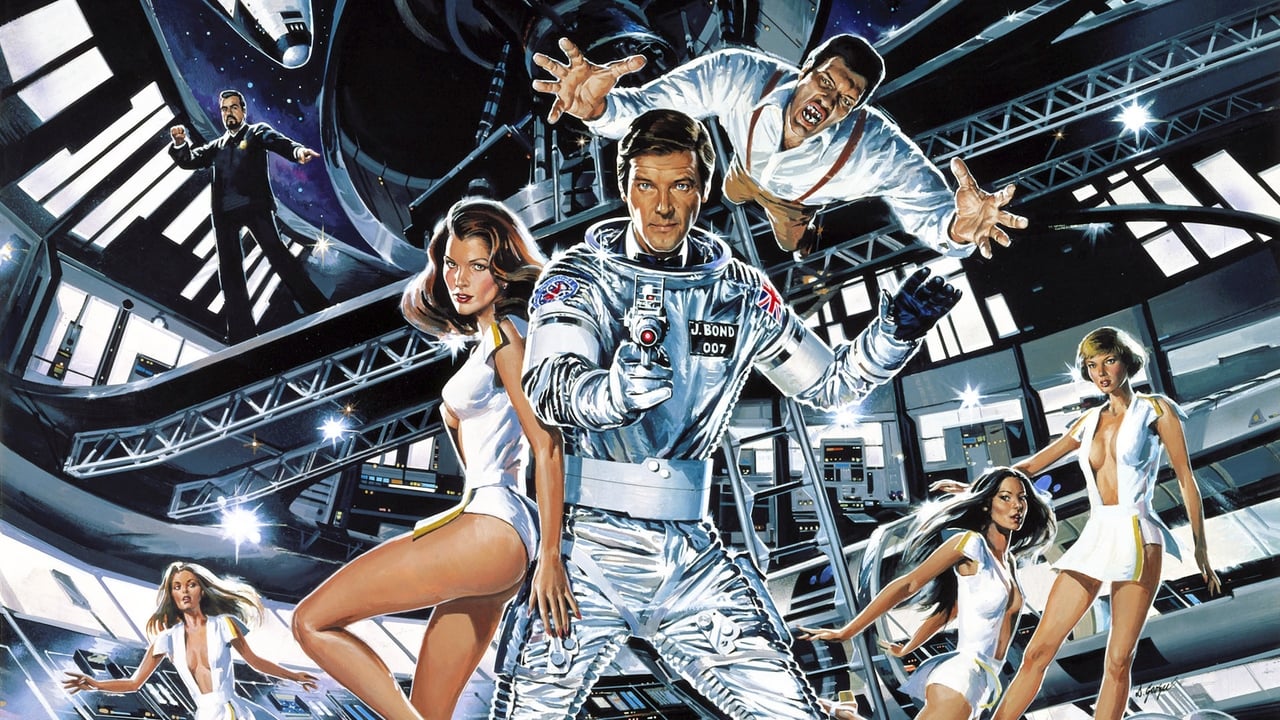
Rewatch Moonraker (1979) after the rise of Elon Musk, and Hugo Drax starts looking less like an outlandish invention and more like a recognisable type: an immensely wealthy aerospace industrialist with his own spacecraft and a personal vision for humanity's future beyond Earth.
The parallels extend to the business. Drax manufactures space shuttles for the US government while pursuing a much larger private ambition. SpaceX has developed spacecraft under NASA partnerships, and its Crew Dragon carried NASA astronauts into orbit in 2020. Musk has also spent years presenting extraterrestrial settlement as a project with consequences for the future of civilisation.
The essential difference is their purpose. Drax plans to murder humanity and repopulate Earth with his chosen survivors. Musk's stated ambition is to expand human life beyond Earth. The comparison concerns private power, space hardware and species-scale ambition—not shared murderous intentions.
What Moonraker captured was the spectacle of a businessman treating humanity's next chapter as a project he could personally organise. Once, that was enough to establish a Bond villain. Today, it also sounds like the opening of a space-industry presentation. Drax's story · NASA's SpaceX mission · Musk's multiplanetary ambitions
6. For Your Eyes Only: Your wrist would like a word
 Image: TMDB
In For Your Eyes Only (1981), Bond's watch receives scrolling text messages and includes a radio transmitter. Even away from headquarters, his wrist can bring work straight back into his life.
That arrangement now feels familiar to anyone who has tried to ignore a smartwatch notification. When Apple unveiled its watch in 2014, reading and responding to messages were among its advertised features.
Bond did not invent the idea of wrist-based communication, and the film's gadget was not a modern smartwatch. But it recognised the appeal—and the inconvenience—of putting a communications device somewhere its owner would almost always notice it. The future arrived, and the boss could still reach you. Bond's watch · Apple Watch's unveiling
7. A View to a Kill: Send in the mechanical snoop
 Image: TMDB
Q's Snooper robot in A View to a Kill (1985) offers a useful proposition: send a mobile surveillance machine to look around, while the human operator stays elsewhere.
Modern inspection robots have made that proposition commercially useful. Boston Dynamics began selling its four-legged Spot robot in 2020, and camera-equipped versions can inspect facilities and collect visual information remotely.
Spot is no replica of Snooper. Its movement, engineering and industrial applications are considerably more sophisticated. The shared idea is what matters: giving a remote observer a camera that can move through the world. Bond's mechanical snoop has acquired serious work to do. The film's Snooper · Spot's commercial launch
8. Tomorrow Never Dies: There's an app for that getaway
 Image: TMDB
In Tomorrow Never Dies (1997), Bond steers his BMW using a touchpad on his mobile phone during a chase through a Hamburg parking garage. The car becomes, in effect, an extremely expensive remote-controlled toy.
Later, manufacturers brought a restrained version of the idea to road cars. Mercedes-Benz described its Remote Park Pilot in 2016 as allowing drivers to move a vehicle into and out of parking spaces or garages using a smartphone.
The real-world feature is designed for low-speed manoeuvres, rather than escaping armed pursuers. Still, the underlying interaction is unmistakable: stand outside your car, operate your phone and watch the vehicle move. The engineers delivered Bond's trick. They sensibly left out the chase. Bond's remote-controlled BMW · Mercedes-Benz's parking technology
9. Tomorrow Never Dies: Q gets your prints
The same film deserves a second entry for another feature of Bond's remarkably overqualified phone: a fingerprint scanner.
In 1997, it belonged among the handset's specialist espionage tools. Years later, fingerprint recognition became a familiar way to access an ordinary smartphone. Apple's iPhone 5s, introduced in 2013, provided a prominent example with Touch ID.
The purposes differ. Bond's scanner serves his investigative and covert work; consumer versions usually verify the phone owner's identity. But the hardware combination—a mobile phone that can read a fingerprint—made the journey from spy gadget to everyday object. Of all Q's inventions, this is one you may already have carried in your pocket. The film's phone · The iPhone 5s announcement
10. Die Another Day: Now you see the heat, now you don't
 Image: TMDB
The disappearing Aston Martin in Die Another Day (2002) tests even a Bond fan's generosity. Its adaptive camouflage projects images of its surroundings across its exterior, allowing the car to all but vanish.
Real technology has achieved a narrower version of that effect. BAE Systems' ADAPTIV system changes a vehicle's thermal signature so that it can blend into its background when viewed through thermal-imaging equipment.
That distinction matters: disguising heat does not make a vehicle disappear before human eyes. Bond's fully invisible car remains fiction. Yet the underlying ambition—actively changing how a vehicle appears to an observer—has a real engineering counterpart.
Q's most extravagant sales pitch turned out to contain at least a little truth. You just need the right camera to appreciate it. The Aston Martin's fictional camouflage · BAE Systems' ADAPTIV