09 Auric Goldfinger
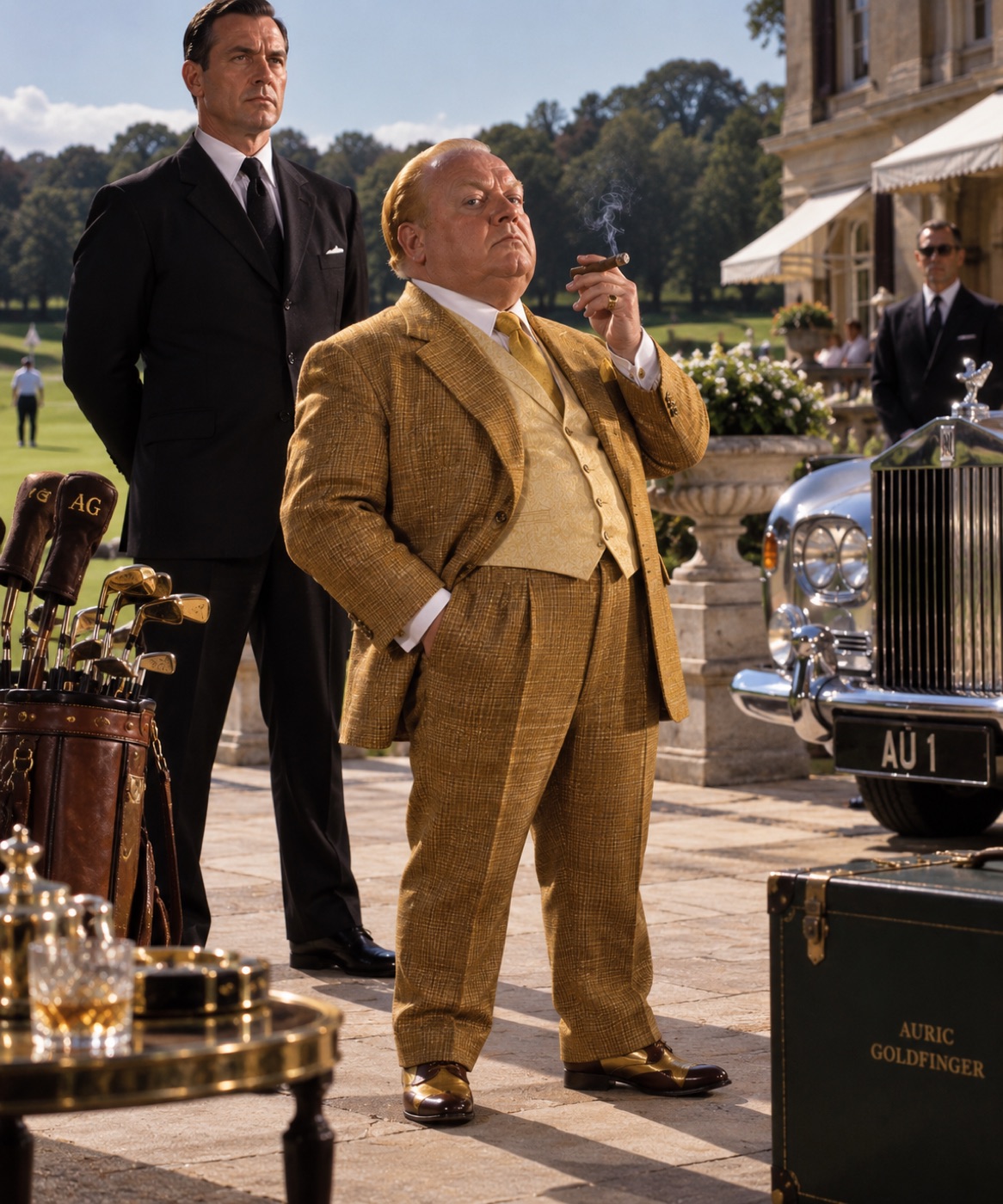
On the page: Goldfinger (1959).
The great surprise is his height: Bond estimates no more than five feet. A thick body, short legs and an enormous rounded head create an unsettling sense of disproportion. Fleming adds carroty crew-cut hair, light-blue eyes and a carefully cultivated tan. This is a more peculiar silhouette than the familiar film millionaire. [22]
On screen: Gert Fröbe in Goldfinger (1964), with his English dialogue dubbed by Michael Collins. [23]
Fröbe preserves the character’s substantial presence and complacent assurance, but the film does not reproduce the novel’s extreme shortness. A standing literary portrait is therefore more informative than a seated close-up: the difference needs a readable scale. Making the head merely rounder would miss the relationship between the parts of the body.
The golf setting is well chosen because it places wealth, competition and controlled manners within one image. It also allows a strikingly small figure to command a generous amount of space. That tension is the visual opportunity.
The most famous off-page anecdote concerns architect Ernő Goldfinger, whose surname Fleming appropriated. A threatened legal dispute ended in an agreement. [24] There is also a particularly cinematic twist to the casting: the voice many viewers associate with Fröbe is Collins’s. [23] The remembered villain was thus constructed from more than one performer even before costume, framing and editing completed him.